

Juggling a busy work-life and the demands of home can be challenging for anyone, but factor in leading a business and being the person that everyone looks to for decision-making can easily multiply the pressure exerted on you.
Recent times have seen a large focus on improving mental health and wellbeing in the workplace, many businesses offer support for employees, but according to findings from The Institute of Directors (IoD)1, there is a risk that leaders themselves are being left out in the cold. There is expectation in a company that those leading the business are expected to be stronger, more resilient, and more capable than those they employ. However, we are all just human at the end of the day.
As a leader, why should my mental health matter?
Despite all the recent advances in opening up discussion on mental health, it is all too easy to dismiss the topic if there is a perception that it’s getting in the way of bigger issues in a business, that somehow you should just get on with it, or the unhelpful perception that you’re just paid more to deal with the stress.
In fact, it’s critically important to focus on your mental health, as a leader, your decisions rely on sound mind and careful judgement, and they affect all of those around you, including your employees, your clients, lenders and the Financial Conduct Authority. It’s likely you may have worked for many years building your business and reputation, and in this heavily regulated industry, each decision has a clear consequence.
One of the bigger challenges experienced by business leaders is the perception that by admitting they are suffering with mental health challenges that they can be removed from their position, for fear that they are unable to cope with key business decisions. In fact, the under legal reforms introduced in the Mental Health (Discrimination) Act 2013, directors can no longer automatically be removed from their post on mental health grounds.
The science of stress
It’s inevitable that running a business will bring higher stress levels than one might have in other roles, and at the same time, there’s a wide body of research available to suggest that many work best under pressure.
However, it’s about how to handle that stress within, and humans by nature are all different, with no one-size-fit-all level of stress that can be tolerated before breaking point.
The Williams Pressure Performance Curve (1994)2 is a frequently-cited example of how pressure can impact the mind of those at work. Not just applicable to company employees, but leaders and directors are similarly impacted – the Williams Curve shows how pressure can increase from beyond ‘Comfort’ stages into ‘Stretch’ and finally into ‘Strain’ and ‘Crisis’ stages.
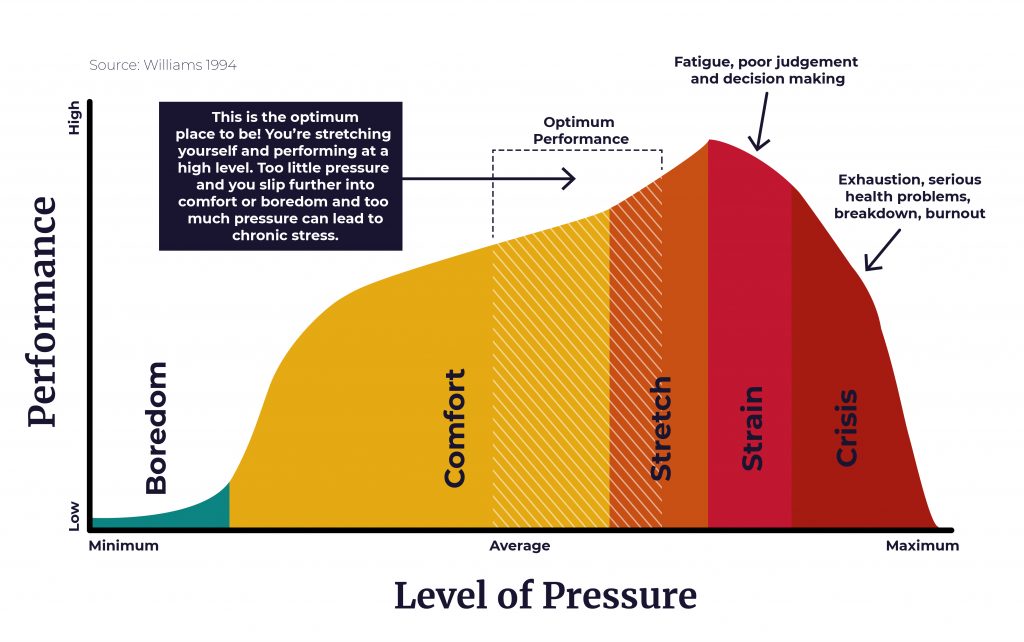
The ‘Comfort’ and ‘Stretch’ stages show the average level of pressure one might encounter at work, the healthy balance, and those moments of ‘Stretch’ where productivity is at its peak, testing our knowledge, skills and stamina over a period of time.
However, the ‘Strain’ and ‘Crisis’ stages that follow can be highly detrimental. Physical and mental health symptoms become more acute, personal productivity drops steeply, the decision-making ability becomes more erratic with an inevitable knock-on impact to business performance and those who have been in this state refer to it as a ‘fuzzy head’ sensation at the point of breakdown and burnout.
Seek help where you can
One of the biggest reasons why stress can be so damaging to leaders and business owners is that it often feels that there’s no one to turn to. You may feel that you can’t talk to anyone in your business, and that’s perfectly fine, but be aware there is always help out there. Many leaders seek help externally at independent clinical practitioner or a professional wellbeing consultant, who may well have been through exactly the same stress-related issue at one point in their life.
Although challenging to do at the time of the stress and illness, the Mind charity encourages business leaders to be open to both junior colleagues and other business leaders about their struggles with mental health, to help others know that they are never alone in suffering.
Why not take the initiative and make your business a safe-haven where mental health issues can be openly discussed?
Sources:
- Institute of Directors (2019) Business Leaders and their Mental Health. Available at: https://www.iod.com/news/news/articles/Business-leaders-and-their-mental-health-campaign (Accessed 17th Jan 2022)
- University of East Anglia (2014) Williams Pressure Performance Curve 1994. Available at : https://www.uea.ac.uk/documents/746480/2855738/PressPerfCurveWilliams1994.pdf (Accessed 17th Jan 2022)