
It’s easy to think of your brand as just being a name, something you see written on a website, email signature or in your letterhead, but it means so much more.
Renowned brand expert Marty Neumeir states “A brand is not a logo, a brand is not an identity, and a brand is not a product. A brand is a person’s gut feeling about a product, service, or company. It’s what turns a customer on or turns them off. And more importantly, it builds customer loyalty over time.”
What can we learn from this?
In the world of mortgage & protection advice, the vast majority of businesses all offer a very similar ‘product’ – so it can be difficult to differentiate yourself from competitors when it comes to attracting new clients. A strong brand can help be the point of differentiation and be the deciding factor in why someone will come to you when they want to buy a home or seek a remortgage.
As we have seen, branding runs much deeper than simply plucking a name out of the air – your brand is everything you stand for, from the quality of advice offered, the location of your business and the breadth of your services, the way you engage with your clients and most importantly – you and your team. These are the key factors that will drive new clients to your business, and see them sticking with you for all their mortgage & protection needs.
Clarify your Purpose
A business exists to fulfil a specific need, so it pays to think carefully about why your business exists and what you do well. Think about your missions, your purpose and how you help your clients. What do you do differently to your competitors that could be classed as a unique selling point?
At this point, there’s some useful theory that can help us analyse what goes into creating a successful brand, using the 3 P’s of Branding1.
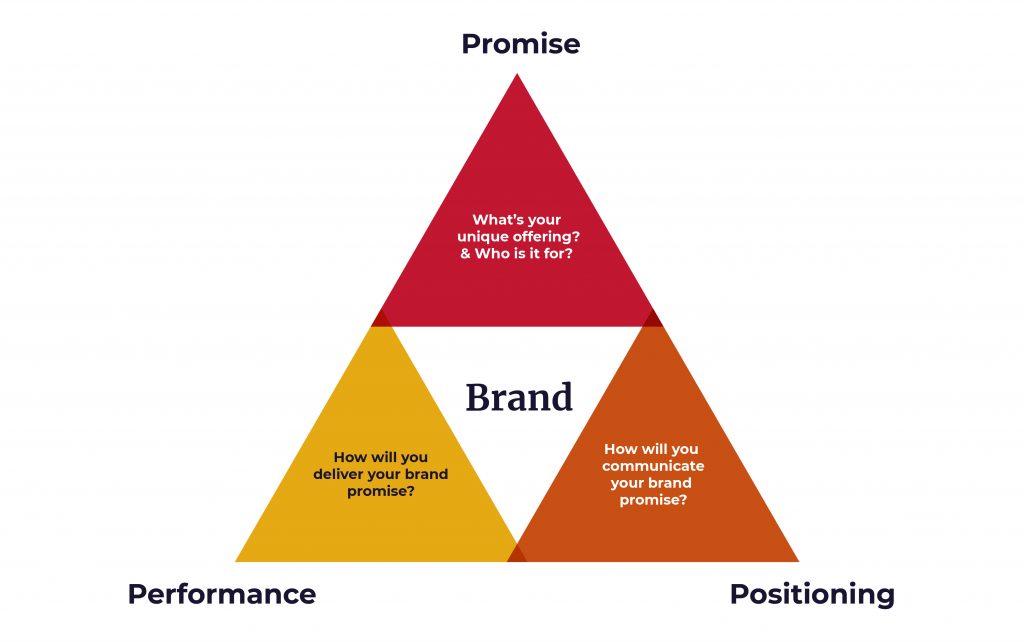
Promise
This element is about what a business offers and who they are offering it to, and with emphasis on what makes your business unique – consider whether is it the friendly, local service offered by your staff, an extended range of products you can advise on, or anything else that makes you stand out.
Performance
This element focuses on how well brand promises are going to be delivered – think about how you will give the quality of service that clients expect, speed and efficiency, ability to deliver a wide range of mortgage & advice products that your clients seek.
Positioning
The final element is built around communication of the brand promise and has strong links to your marketing strategy & activities. It assists the target market to create a specific space in their minds for the brand separate from other brands that they know of – this could be the logo your company uses, the colours, your communication style, your premises, and more.
Key Questions to Ask of Your Business
- What does your brand represent?
- Who are your target audience and how will your brand resonate with them?
- How do you represent it? What assets (Logo, visuals, tone of voice, service) will you develop?
- What do you want to see, and what do you visualise in five to 10 years’ time? And can it still be relevant in five or 10 years’ time, or maybe even 20 years?
Building Your Brand
Having first considered the above aspects on what your business does, who it appeals to, what it excels at and your unique selling points, now you can start to think about the kind of brand you would like to project to your audience of clients.
Logo & branding design
A good company logo will come out of its brand, rather than vice versa. The reason being that the logo represents your brand and your business, and will resonate with your target audience. A logo designed for high-net-worth clients may be very different to a more mass-market business for example, and a poorly-considered logo can easily alienate an audience. When creating a logo and branding, consider how the assets back up your business aims and purpose – they should be a good fit in order to be successful.
Tone of Voice
Your business’ brand has a voice, in terms of the messages you convey, what you say and how you say it. Be mindful that this has a big impact on how customers perceive your brand; your communications will have a mood or emotion conveyed, and these need to be thought about and aligned to what you and your business stands for, to seem genuine.
It’s easy to create a point of difference through good use of your tone of voice – and studies on human behaviour2 have revealed that 40% of consumers stated that they prefer memorable content, 33% value a distinct personality and 32% prefer compelling storytelling in communications. This goes to show that your tone of voice and how you express yourself impacts the way your clients will think about your brand.
Define your Values & Standards
In a successful business, the core company values drive the behaviours of the team within. This covers anything from the way you interact with each other, how you talk to your clients and work with lenders and your mortgage support network.
It’s important to define the values within your business and what it stands for, and this can then flow through to how you and your workforce act, to truly get on board with the company values, driving the right behaviours and sharing the same standards to give all of your clients the same great experience.
Summary
A brand is far greater than any one single item and is linked to the overall reason why your business exists. Companies that are successful have a cohesive brand that fits in with their aims, objectives, service and customers, and they know why they stand out from the competition. The look and feel of everything a client sees or hears from that business is aligned to its values and purpose, so it’s always clear what the purpose is, and the customer is given the confidence to do business with them on a long term basis. By taking time to think about what your business’ purpose is, you can start to unlock the other elements to ensure your branding fully reflects what your business does.
Sources:
- Fill, C. and Turnbull, S. (2019) Marketing Communications: Touchpoints, Sharing and Disruption, 8th ed. Harlow, UK: Pearson.
- SproutSocial (2021) Stay Ahead of the Social Consumer. Available at https://sproutsocial.com/insights/index/ (Accessed 19th Jan 2022)